

The Fourth of July is still about family – even as Americans feel the holiday is becoming more commercialized

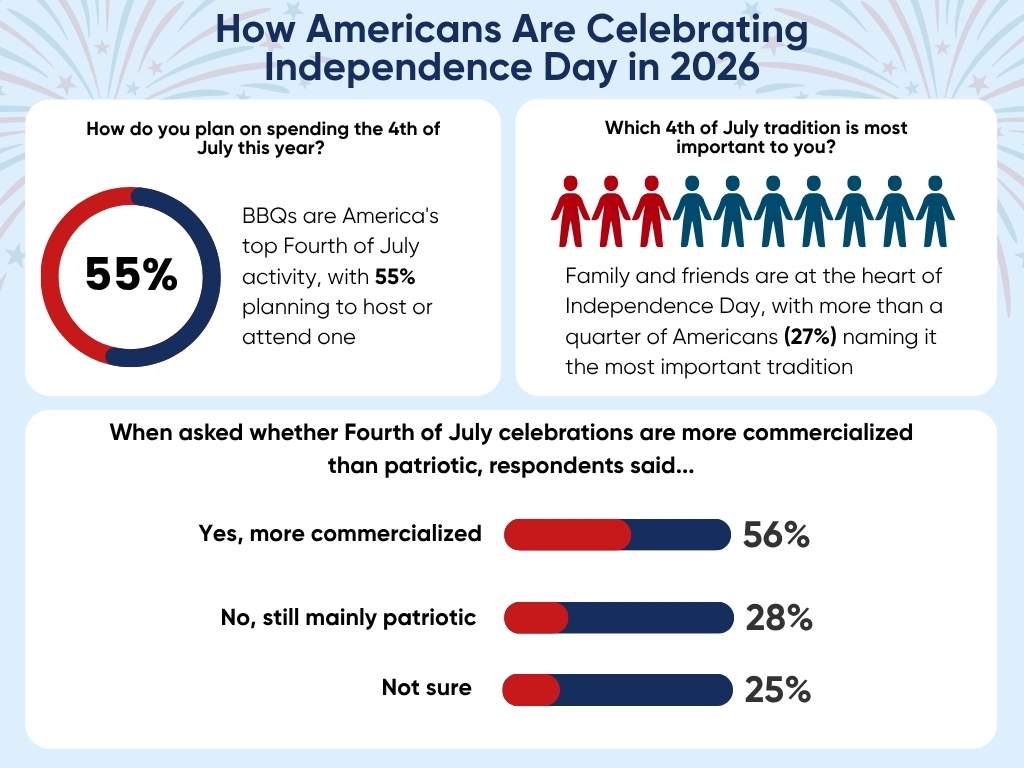
New survey reveals Americans are prioritizing cookouts, fireworks, and time with loved ones this Independence Day, despite concerns about rising costs.
The Fourth of July has long been one of America’s most recognizable traditions. From neighborhood cookouts and fireworks displays to road trips and community celebrations, Independence Day remains a summer staple for millions of Americans.
A recent survey of 2,000 U.S. respondents by Mecca Bingo suggests Americans are approaching the Fourth of July celebration a little differently in 2026. Rising prices, shifting priorities, and growing perceptions of commercialization are all influencing how people plan to spend the holiday weekend.
Even so, one thing remains unchanged: for most Americans, the Fourth of July is still fundamentally about spending time with family and friends.
Cookouts and Fireworks Continue to Define the Fourth
When asked how they plan to celebrate Independence Day this year, Americans overwhelmingly pointed to two classic traditions.
More than half (55%) said they plan to host or attend a barbecue or cookout, making it the most popular Fourth of July activity in 2026. Fireworks remain nearly as popular, with 51% planning to attend a fireworks display.
Beyond those staples, celebrations become more varied. Nearly one in five Americans (18%) plan to attend a parade, while 16% expect to travel or take a vacation. Another 16% said they plan to spend time at a beach or lake, and 13% intend to attend a concert or festival.
At the same time, 17% reported that they don’t typically celebrate the Fourth of July at all, highlighting national holidays are becoming increasingly personal rather than universal.
Family comes before tradition
Although fireworks and cookouts dominate public celebrations, Americans say the people they’re with matter more than the activities themselves.
When asked which Fourth of July tradition is most important to them, spending time with family and friends ranked first, selected by more than a quarter (27%) of respondents.
Fireworks followed at 24%, while barbecues and cookouts came in at 22%.
More traditional patriotic activities ranked significantly lower. Just 8% identified parades as the most important part of the holiday, while another 8% chose displaying the American flag. Patriotic concerts and music were selected by only 3% of respondents.
The results suggest that for many Americans, Independence Day has become less about formal patriotic observances and more about creating opportunities to gather with loved ones.
More Americans see commercialization than patriotism
While Americans continue to celebrate, many believe the holiday has changed over time.
A majority of respondents (57%) said Fourth of July celebrations today are more commercialized than patriotic. In contrast, under a third (29%) believe the holiday remains primarily patriotic, while 14% are unsure.
For many, the Fourth of July is less about symbolic displays and more about spending quality time with family, friends, and local communities.
Most Americans are staying close to home
Despite the holiday’s reputation as a major travel weekend, most Americans aren’t planning to go far this year.
Over half (54%) of Americans said they intend to stay local this Fourth of July. Under a third (29%) of Americans plan to travel somewhere within their state, whereas 17% expect to travel out of state, equating to roughly 44 million Americans.
Americans are celebrating with budgets in mind
Economic concerns are also influencing how people plan to celebrate this year.
Almost one in four (23%) expect to spend between $25 and $49 on their Fourth of July activities. Another 22% anticipate spending between $50 and $99, while 19% expect to spend less than $25.
One in six (15%) Americans plan to spend between $100 and $199, while only 6% expect to spend more than $200.
Notably, 15% said they don’t plan to spend anything at all.
The numbers suggest that while Americans are still eager to celebrate, many are doing so with careful budgeting in mind.
Inflation is affecting holiday plans
For many households, rising costs are having a direct impact on how the holiday unfolds.
Two-thirds of Americans (66%) said higher prices have affected their Fourth of July plans in some way. More than a quarter (28%) reported being significantly affected, while 38% said rising costs had somewhat influenced their decisions.
Over a third (34%) said inflation had not impacted their plans.
Rather than canceling celebrations altogether, many Americans appear to be adapting by staying local, reducing spending, or focusing on lower-cost activities that still allow them to participate in the holiday.
A holiday that’s evolving alongside America
The Fourth of July has changed dramatically over the decades. What began as a day centered on civic ceremonies and patriotic observances has expanded into a broader cultural event that includes travel, entertainment, food, and community gatherings.
The 2026 survey suggests Americans recognize those changes. Many believe the holiday has become increasingly commercialized, and rising costs are influencing how they celebrate.
Yet the core appeal of Independence Day remains remarkably consistent.
Whether they’re gathering around a backyard grill, watching fireworks after sunset, or spending the day with family and friends, Americans continue to use the holiday as an opportunity to connect with the people around them.
In 2026, that sense of togetherness and family appears to be the tradition that matters most.
Methodology
To uncover the Fourth of July attitudes, Mecca Bingo conducted a nationwide survey of 2,000 U.S. respondents in June 2026. The survey is nationally representative of age (25+), gender and state.